Friday, May 28, 2010

New York or bust

Well, we leave shortly, and are excited about that, but not about flying. Seasoned flyers (Carol used to work for Alaska Air), we don’t enjoy it so much anymore. Tough to get old, but security gates are mentally daunting and physically tiring now. Can’t wait to get there.

The best part will be seeing old friends, and relaxing, once we’re there. Our kitty and our house are in capable hands, so we can enjoy our stay without worry.

See you in NY, if you’re there. I’ll be writing from the road, so to speak.

Friday, May 22, 2009

How time flies...


Just looked at the last post, 8/25/08, nine months ago. Anyone who regularly reads this (and I'm pretty sure they don't exist...) would think me dead, lazy or too ignorant to know how to post more "thoughts" to something I once desired to turn into a book.

How does one turn into a book, anyway? Would it be like the young folk going into a closet to Narnia? Or maybe stepping into a mirror or going down a rabbit hole? If one could "turn into a book, would it be a paperback, hardcover or comic book? I rather think the third choice for my life. Too bad I can't draw well. The sense of humor is there, otherwise it would be a different type book entirely. Maybe a Gothic novel, or a horror story.

I've thought about writing the latter (Gothic novels would be too hard for me, as I'm not fond of the genre anyway) but something stops me every time. It is the simple ideation of things evil that bothers me. If one can think of horrible things, could one find oneself doing them? How does one of my favorite mystery writers, Jeffrey Deaver, do it? We all have a dark side, and probably everyone thinks of things they shouldn't now and then, but actually constructing a novel around them? Maybe I should try. Seems like horror sells nowadays. Just look at all the CSI shows, and the gory lab scenes in NCIS, Medium, etc.

Well, enough black thoughts. It's been too long since I wrote upon this page, at any rate. We are about to embark on another, albeit much abbreviated, trip to Clayton, NY. We have put the trailer with screened deck up for sale (since last June, actually, when we decided gas was just too expensive for a cross country trip) and are going to visit it one last (we hope) time to try to sell it occupied. That's how it would show best, not musty and smelling of moth balls and dust from two winters alone gathered in the corners etc. We hope to see many old friends again, and one of them is the River itself.

Many times in the last 21 months our thoughts have turned to old haunts and good warm conversations. We've often commented on how much this or that sunset reminded us of our nights on the Clayton dock benches, even thought there really is no comparison between AZ and NY sunsets, and you can't see Calumet Tower in the middle ground under the pinking clouds. You can imagine it though, and conjure up the faces of old friends. I'm looking forward to sitting in the back room at the American Legion, watching the same sun setting over the same river, and imagining that Carol and I are enjoying a beer or two while the ball drops. Alas, the beer is out, as my medication prevents me from even a sip. But to just imagine...

We need to get our Hoffman's hot (her's red mine white) fix at the Castle too. Can't get those in AZ. Wish we could. And a ride at the beginning of the evening, after supper, to circle the wild area of French Creek by way of the Deferno Road, and cross the creek to stop for spring water at Frontenac Crystal Springs. This used to be a weekly ritual, and for a short time it will be again. We'll marvel at the sunset dropping bright sparks on French Creek Bay (now French Bay,it seems) as we cross the highway bridge over the creek itself, and look over to where our little trailer summer home sits in the shade of a huge old willow.

Of course our trip would not be complete without visits to our old places of employment. The Magical Swan in Alex Bay for Carol and The Antique Boat America Showroom near Fishers Landing for me. We would have spent the whole summer there, perhaps working in the same spots again this year, under different circumstances. Now we both have jobs in Tucson we must return to or lose them. In this economy, it's not good to abandon a job!

Yes, please, if you are in the area (or are lucky enough to live there) please do visit us while we're there. We leave Tuesday the 2nd of June, and will be in Clayton until at least June 10th, after which we plan to go visiting our southern New York friends and neighbors, and family. So, until we meet, by chance on a bench by the town dock or the old coal dock, enjoy your summer! And if we don't get to meet, be sure to hoist a cold one for us.

Joel

Monday, August 25, 2008


Friends sent me an urgent email to be sure to vote in the MSNBC poll asking if the phrase "In God We Trust" should be removed from the currency. The intructions were to forward it to everyone, so they would vote and show their faith in God. It was a forwarded version that I got, and ended with the speculation that MSNBC would be surprised by the outpouring of outrage represented by "no!" votes.

Personally, I don't think most Americans are as worried about this poll as are worried about where the next mortgage payment is coming from, but it is a real poll by MSNBC. I checked out the MSNBC website itself, as I'm always reluctant to go to a web site purporting to be any organization's web address without checking the real site for fear of a security risk. It is real.

I doubt MSNBC is surprised. The stats are now up to 79% no 21% yes. Most people know this is not a political reality, and MSNBC is simply publishing the result. We haven't yet, but soon we'll be hearing about internet stories claiming Obama supports such a silly nonexistent law. I'm pretty sure he doesn't/wouldn't, but there is bound to be someone out there who will claim he did/does/would....

There is not now, nor has there ever been, a serious challenge to "In God We Trust." Every so often a foolish atheist files a dumb lawsuit. That was what this rather ill advised poll was about.. Rarely do they win significantly. Even prayer in the schools is not "banned", it is merely prohibited as a requirement. Anybody wants to pray in school is and should be free to do so. Nobody, however, should dictate to anybody else how or to whom or when they pray. That is between man and God. God has way more authority then Congress. Only the Taliban seem to really want to dictate these terms so far. I hope we don't become like the Taliban.

Incidentally, I voted to keep the coins the way they are. Hope the judge sees the poll.

Saturday, July 05, 2008

Google me sometime, please....

Well, they finally got around to us. Not Big Brother, Big Google. By going to http://maps/google.comand looking up 3003 W. Broadway Blvd, Tucson, AZ 85745, you can "drive" around our complex andlook at (pretty much) every house, including the club house. Can't see the pool, though. Now, since I don't plan to do anything illegal, this doesn't bother me as much as it seems to bother some. I just think it's kind of humorous that it isn't Big Government that's doing it: its Big Biz.

In the street level photo, "look" to the east as you "drive" up Maricopa. We're just around the courner, with two hugh saguaro in front. It looks like Carol was working and I was home (or both out in her car) because our van is in the drive, but nobody came knocking at the door to find out. They just drove around video taping, I guess. Google hasn't updated the satellite photo (or high altitude photo) as it still shows the park's old pool and the un-renovated club house, even though the street view photos show the "new" one. If you "drive" all the way 'round the park, you can catch a glimpse of a few local folk out for a drive or a walk.

Burglars don't know how to use computers, do they? Or, do they......? Hmmm. Now for the really frightening stuff. There's even a topo map function that shows the hill behind us, also visible in the next photo (picture the topo map rotated 180 deg.). Pretty neat! Everything a terrorist would need to know, should one want to find out. Try (if you haven't already) looking up your own neighborhood. Or some defense installations, or Yankee Stadium.....Including driving directions! Or the Holland Tunnel, perhaps.....

Scary, huh? This took me about 15 minutes to find and paste into an email. Most of the timewas spent cutting and pasting. The finding part was easy.... Somehow, having my house in the pictures isn't as worrysome as the last two. One of them was actually a target not long ago! Maybe we give too much away?

Sunday, June 29, 2008

Lighning Rod? I don't think so!


When I heard the thunder I did what any red blooded photog would do: I grabbed the digital camera and ran outside to see what the first monsoon in this year's long march of thunderstorms would bring. I've done it many times before, probably will be MUCH more careful from now on. I ran out the way I was. It was hot, and we don't keep the AC down real low (80), so I was wearing sweat shorts only, no shoes, no shirt.

I walked carefully to the end of the drive, snapping stills of the black, roiling clouds to the south. When I reached the street the first rain drops began to fall, but the hot pavement was still dusty dry and stony enough to slow me down. The next roll of thunder sent me slowly back under the edge of the aluminum carport, watching the sky. I saw flashes off to the south, over the top of the "mountain" (really a 250' foothill of the eastern Tucsons. A quick twist and the camera went from still to video. The camera pointed at the sky to the south, I waited for the next flash, hoping to catch a lighning bolt striking behind the mountain. I got one. Captured it to video, by golly.

And while I was doing that, looking in the 2 1/2 inch screen for the image, my eyes drifted fromthe camera to an area in the clouds directly above my head. Standing as I was only 2 feet out from the carport's aluminum edge, I couldn't see all of the sky above. I could and did see the pretzel like shape of a huge cloud to cloud bolt, or the edge of the pretzel, directly overhead. Now I know what "my hair stood on end" means. When I was in high school we had a gent who brougt in a Van de Graf generator for an assembly demo. He called for volunteers to help set up, and our physics class got to be the set up crew. You can guess the rest. Got the full experience. In case you don't know what one is, Google it. It's not as much fun as it looks....

Neither, it turns out, is "nearly" being struck by lightning. My hands started tingling, all the way to my elbows, and so did my feet and legs: just like the generator of yore. Without shutting the camera down, I beat feet directly back in the house, getting a good sequence of said feet and the opening and closing of the door, along with full audio of me swearing.... Note the bare feet... how dumb is that?

http://vupload.new.facebook.com/video/video.php?v=43276290970

Friday, January 19, 2007


Anybody remember this place? Spent much of my misspent youth there, putting nickels and quarters in the juke and watching the river go by, fooling around with friends. It wasn't called "Harry's" then. What was it called?


Wednesday, January 17, 2007

If you've seen this blog (and most haven't, I can see from the number of hits...) then you've seen this photo in the profile attached to it. The kitty is Boo Boo, as in mistake. She really wasn't, but when we first got her not long before I had open heart surgery, we thought she might have been.

She kept us up at night, playing. She developed a hairball cough from licking her fur too much, even though she's a shorthair. She was hyper most of the time. Then her post kitten personality kicked in. We still call her Boo Boo, but she has become an indispensible part of our gypsy household. We taught her to travel with us to Clayton, NY by taking her on progressively longer rides in the car. She took to staying in motels (we use Days Inns almost exclusively now, as they will take pets when most others won't) and settles right in when we let her out of her transporter. She'll be accompanying us on our 5th drive to Clayton this May. She settles into the Clayton routine quickly, using the screened porch as an observation post to keep track of the birds, squirrels and the neighbors' dog.

Carol really didn't want another cat after we had our 22 year old black and white Siamese/American Shorthair Minky put down; but we had been cat "owners" for 40 years, and after a summer without a cat, and me having grown up with a cat or three always present in the house, I convinced her we needed to have one around. Anyone seen the recent news about cat owners living longer?

As I said, we thought at first we'd made a mistake. Then we found that she thought she was a dog, or maybe a person. She's not like other cats. She actually fetches things that are thrown, with a particular fondness for the white plastic circles from paper milk carton tops and the tear off hoops from OJ bottles. I won't bore you with video footage of her trotting back proudly with one of the latter in her mouth like a retriever. She has become so devoted to this form of play that you would think she was one those police dog trainees being rewarded with her favorite toy. Unlike other felines, she comes right to the door with a friendly dog-like greeting, wagging her tail and meowing to tell us about her day when we've been gone more than a few minutes. Most cats would sulk and ignore their "owners" if they left them alone for a day. Not her. She makes it known that she's glad you're back, and wants to play right away.

She's three years old, very small, petite actually, and you can tell that she's our baby. We tell ourselves that that's OK, because our kids are grown and moved on. So we spoil her like an only child.

Bragging....


Repeat after me: Never brag about the weather....it can change VERY quickly. We're out in the cold now, and it's cost us two frozen pipes and days without (horrors) voice mail on my cell phone! Seems that Tucsonans and Tucson businesses alike are truly not prepared for the big freeze. Alltel's switch gear got doused and caused the latter, and a forgetful homeowner leaving an outside waterline on the former. Ironically, our community pool opened last week after nearly a year of closure due to renovations, and we can't use it much! The water's heated, but boy it sure is cold getting out... Oh well, February is usually warmer (we hope!) Probably this fountain will have thawed by then.

Tuesday, November 21, 2006


The Summer Place, in Clayton


Another bleak winter in Tucson! Blue skies, no clouds, temps in the 80's. Ho hum! Need a little rain... Well, we'll be back in NY in 2007, ready to enjoy river views and sittin' on the deck in the cool breeze. Real grass too! Can't wait.

Monday, February 13, 2006

Laziness, and the lack of drive - writer's block?

After discovering that I have a raging case of rheumatoid arthritis (I never do anything that isn't dramatic, anymore) I just spent the last 5 and 1/2 months recuperating from a torn achilles tendon. This has been my excuse for not writing or posting any more of my narrative about growing up by The River. Finally, the decision to start on a treatment program for the RA (as it is called by those who treat it and suffer from it) paid off a couple of months back, and I can use a keyboard again.

OK, so its and excuse for writers block. But I'm back now, and ready to bore anyone who might venture here to see what the latest is. A quick look at the comments section tells me that it is a small number indeed. Oh well, at least some are reading it. I get something out of writing it. There's also the interest in other people's blogs as well. Some are quite entertaining and informative. Hope this stuff is not to boring for all of you experienced bloggers out there, but like the TV and the radio, there's always tht "off" button.

Joel

Chapter 4: Fire

Firebug is a term that has been around for a long time. I was first aware of it as a child. Fire has had a strong effect on me, since I grew up behind the firehouse, mostly positive. Fire has had many faces, almost all dating back to Clayton. Let’s start with the firehouse.

My Grandma used to read me a story about Freddie the Fireman. It was a book with moveable parts, including a fire truck that wiggled left and right on a pivot, as though it was bouncing along the street, and a hook and ladder truck. There was a fire dog, a Dalmatian, and all kinds of fire apparatus, including a tall tower where they dried the fire hose. The Clayton fire hall had such a tower, on a smaller scale, and I seem to remember hoses hanging in it. I don’t really know for sure, because it is gone now. The firemen were loud and boisterous men, who would take the time to talk to youngsters like me. I don’t really remember any of them in particular, because we moved a distance away when I was about 4, and it was too far away to visit. What I do remember is the old fire engine that made a lot of noise, and was polished a bright shiny candy apple red. It had the word “Calumet” painted on it in fancy gold letters, though I could not read them at the time. Years later, I would see it again and again in parades. I often wonder what has happened to it since. There was a competition between fire departments, and there still is, to see who could lay out a hose fastest, and other things they now call “firemantics.” Those contests always seemed to me, as a youngster, to be a contest to see who had the loudest, most powerful truck. The trucks were special, seemed to have been cut down from normal size, or maybe they were specially built that way. At some point in my life it became clear that the firemen were there to protect us, and not at all to be feared. To this day, my favorite section of a parade is the fire department. All the members in uniform, the shiny engine with its diesel rumbling, big tires rolling along, and people waving from the platforms meant to hold firemen (or, today, women), were magic to me and still are. I never really wanted to be a fireman, because I knew that my lungs were never going to be strong enough for the smoke involved. That and the fact that I was really afraid of fire!

I think all children go through a stage where the attraction of fire is dangerous for them and those around them. Part of my adult life was spent as an insurance adjuster, and I had my share of tragic fire claims where a child “accidentally” burned down the family home while playing with a lighter or matches. I think it can go either way. Freddie the Fireman was also a TV show in the 50’s, with a real person playing Freddie and telling children to be careful with fire. It is a known fact that children who are fascinated with fire sometimes grow up to be firefighters, some of whom become “firebugs.” The desire to become a hero, the need for recognition and rarely, the need to set fires drives some of these. I think most are driven by the feeling that they are doing good for the community in which they live. I admire people who can go into a burning building to save it or the people inside, putting their lives on the line for us every day they go to work. I could not do it.

When we lived in the house down the street from the school, I awoke one night to a flickering orange glow against the drawn shades. The fire siren was wailing, and I had been having a very bad dream. I must have cried out, because my mother came into the room and comforted me. It seemed that the house next door was on fire. The house, which had seemed so far away, now seemed too near, and the heat could be felt if one stood near the window on that side. Fire trucks arrived, and the fire, which seemed to be alive and dancing inside the windows of the house, was put out. I was unable to sleep, each time I drowsed going into a terrible dream about fire. Our house was, in the dream, much closer to the fire, and in danger of burning.

It wasn’t, of course, but the dream was persistent. I have no idea how long it went on, but there were other things making it difficult for me to forget it. One summer night we saw someone walking around the outside of the house that had burned, muttering, with a can of liquid. They were pouring the liquid, probably kerosene, on the house. The back part of the house was a burned out shell. It did not burn that night, for some reason. My parents reported this to the fire department or the police, and some men came to our house on a “stakeout” and lay out in the yard at night waiting for the “firebug” to try again. After several days, it happened again, and the person was dealt with in some way I did not understand at that age. Since I never researched the situation, I still don’t know exactly what happened. All I know is that the nightmares went on for a while. On some level, I must have worried that our own house would be “torched.”

In the next few years, the front of the house was home to a small store, a residence again, and then an empty shell. Briefly, it was home to a black workman who was employed by the contractor constructing an addition to the school. It was the 50’s, and he could find no one in town to house him. I knew little of this, only that he was turned away, and ended up living there. We used to talk to him every now and then when we passed by. He seemed a polite man, and pleasant to talk to. Eventually, the little shanty was torn down or moved, and the empty house foundation, weed choked and blackened, was all that remained. I used to walk to school through the lot behind the house, and could never pass it without remembering “the Fire Bug.”

That period of time contained another fire incident. An older, playmate and I were in the garage behind their house and found some matches. I don’t remember much about the reasons for it, but Phil and I decided to stuff some grass in a coffee can and make a stove. We set a match to it, and watched it burn. Somehow, the can tipped over and suddenly the dry grass around the “stove” was seething with tiny flames. We tried to stomp them out, but the wind drove the fire toward the high grass and dead weeds in the lot next door, the lot next to my house and the lot next to the firebug’s house.

I don’t know who called the fire department, but the next thing I clearly recall was being inside the house, with Phil’s mother giving us cookies. She must have called my Mother, as Mom arrived some time later, very upset because she hadn’t been able to find me, and the fire had been so intense. She was not angry with me, though I’m sure she knew how the fire started. She was very calm after the relief she must have felt in finding me. When I got home I expected Dad to be there, but he wasn’t. When he did come home, the anticipation of being punished was much worse than being punished. He probably knew that, and merely gave me the same treatment I often gave our children: the dreaded lecture. Our children have told me that they dreaded my lectures more than anything else! While Dad was likely to spank me for extremely bad behavior, the lecture was most likely. He didn’t need to say much. He took me outside and pointed out the burned area. The fire had burned over nearly the entire field and much closer to the house than I felt comfortable with. We had a nice green lawn, and the fire burned right up to it, and also very close to the garage of the house on the next block. My grandmother’s rhubarb patch was not affected, nor was the sweet pea vine along the back fence, or my Mother’s garden. But it was a big fire, to me. Dad explained about how things could have been worse, and that many small animals and birds were probably now homeless. From that point on, I was very careful with fire. Not that I quit playing with it. But I had learned that fire had very bad consequences, and I never again played with matches or any kind of fire near anything that might catch fire and spread; and never in the house. Somehow, the experience taught me a healthy respect for fire, but Dad also pointed out the good things a fire could do.

When I was older, I was put in charge of trash burning; a weekly chore akin to putting out the garbage. You can’t do that in many places now because of anti pollution laws. It’s the same with leaves. One of the rewards for the arm wrenching, back twisting job of raking leaves is, when you’re finished, setting fire to the leaf pile in the side yard (carefully placed so as not to be a hazard) and standing back to watch the pungent smoke and tiny flames leap and roll out of the fire. On the days which were too windy for raking leaves (they blew back at you) it was also too windy to burn them. When the time came for clean air conservation and big leaf bags, the task of leaf removal became much harder.

When I was about 15 years old, Charles Emory’s beautiful red granite Calumet Castle, built in 1893, burned rather spectacularly. Mom, Dad and I had taken Dad’s pride and joy, an 18 foot Lyman Islander Inboard (we could afford a boat by then) for a bass fishing trip on the Canadian side of Wolfe Island, the largest of the Thousand Islands. We caught several good sized large mouth bass, some perch, and a small pike. Mom also caught an eel, and we cut the line, but that is another story! At about sunset we started back after eating a cold supper of sandwiches. It was beginning to get dusky as we rounded the north end of Wolfe Island and headed home, and the sky looked strange downriver. As it got darker, a large area of the sky actually glowed.

When we cleared the last of the islands separating us from a direct view of the center of the river opposite Clayton, we saw flames reaching hundreds of feet in the air over Calumet Castle. It was on fire! As we got closer, we could see many small boats and some larger boats upriver from the end of the island, near what was once called Governor’s island. There was no way any attempt could be made to fight the fire. It burned into the night and the next day. When it was out, nothing but the steel and granite was left. The mystical red castle was gone, now just a blackened pile of granite. It took a long time, however, to erase all traces of it. A demolition contractor finally brought down the walls by blasting them with dynamite charges, which we watched from the riverfront park.

Today the water tower still stands, and the place where the castle stood is a beautiful green lawn with a flower garden in it. The sheltered harbor holds a marina “boatel” operation. I miss seeing it still. If you look at the little memorial tower in the center of town by the waterfront, you can see the color of the stones used in the castle. I was fortunate enough to have been on a tour of Calumet and some of its mysteries courtesy of my brother, Jim, years before it burned. It had run down considerably, and was in a sad state even then.

One day in my senior year (1959-60) at CCS, Dad and I were clearing brush in our back yard near the property line fence. We were nearly finished when I saw a large black column of smoke to the Northeast. When I pointed it out, Dad said that it was probably on Round Island. At that time you could see the river from our back yard, but now the area below is quite overgrown, so I doubt you can anymore. We moved over to the corner of the lot, and I climbed an apple tree to get a better view. Still, all I could see was the smoke. We went to the car and drove down to Steele’s point to find out if we could see better from there. The fire was on the north side of the island, near the head, so we could not directly see what was burning. We went home, and later found that a large home had burned to the ground: not surprising in view of its age and the dryness of the wood it was constructed with. Of course we didn’t find that out the way one would today. There was no “breaking news” to see on WWNY or any other TV station, so we did not get the news immediately. Some days later we went out in the boat and rode past the site of the fire. To me it was and is a tragedy to have lost such a fine old house. Not, I suppose the equivalent of losing the magnificent Hotel Frontenac, but still tragic. I was, in my life before retirement, in the insurance business, with six years as a claims adjuster. I discovered that no fire, no matter how small, is less than tragic to those who experience it. Money can not replace the photos one lost, or the one of a kind wood sculpture your son made in his college art class. Nor can it completely erase the memory of the building that once was

Many years after the fires of my youth I became an Assistant Scoutmaster. One of the functions of Scouting is teaching responsibility and self reliance, particularly with tools and around one of our most awesome and dangerous tools: fire. As a leader I learned that boys will play with fire, and can be taught to respect and use it properly. It became a matter of pride to teach proper fire skills and campfire etiquette. Unchecked, boys will build four foot high campfires to cook a small pot of soup and a hamburger!

One cold overnight in my first year as ASM of Troop 11, Peter, our troop’s Scoutmaster, took the younger boys who needed hiking merit badge work out for a walk in the woods. I was left with some bored older boys to work on fire building skills for an up-coming Camporee event. They weren’t interested. Each had brought a spare time activity of his own choosing, such as a deck of cards or a chess board, and felt that now was the time to get out of the wind and into their tents. Since it was a bright sunny day, though cold, it seemed that fires were an excellent idea. I set up some twine, tied between vertical posts about three feet apart. One string was tied at a foot above ground level, the next about two feet above that. The older boys watched, occasionally making derisive remarks and stating that they knew all about building fires anyway. I gathered the remaining, younger boys in a circle and explained the rules of this common Scouting skills game: gather the kindling and wood, lay the fire no taller than the first line, and burn through the second line. Whoever did that first would win a candy bar for each boy in the patrol.

Again, the older boys scoffed at the game, but soon saw that they were being left out of an activity they had been invited to join! It wasn’t the candy bar that got to them; it was the opportunity to prove that they were better than those Tenderfoot Scouts at whatever they might do. Soon they were out gathering wood, helping the younger boys pick the right kindling, the right kind of wood to catch quickly and burn hot enough to cut the string. I even heard one explain that “you don’t use the same kind of wood to cook, Timmy, because it doesn’t make good coals;” something I’m sure he learned from Peter or me. The first patrol to burn through their string got the candy bars, but the others asked me for more string, and even though the candy bars were gone, they all re-set the fire contest and tried again, several times. The following week, the camporee saw Troop 11 win the string burn contest.

As time went on, those boys, who thought teaching younger kids how to build a fire was something I should do, learned that doing the teaching themselves was fun! Did I teach them this? No, I didn’t: the Scouting method did. But I learned something in the process, too: teaching someone else what you know is less rewarding than having them find out the same thing by themselves under your guidance.

As a result, I remained in Scouting, working in this way whenever possible, for nearly 25 years. Some of my best memories derive from Boy Scouting, an activity which I started as a lowly Tenderfoot Scout in Clayton, NY. Many of those memories involve starting a campfire and working with it. It's funny how it now looks like a circle to me. Most of my adult vocation was also wrapped around fire. I was, primarily, a fire adjuster for the Insurance Company of North America. I became a career fire insurance agent (among other insurance forms) with Perry and Swartwood, in Elmira, NY. I taught a business course to Elmira College students, a good portion of which revolved around the NY State Standard Fire Insurance form. Fire has literally paid my way through life.

Chapter 5: Scouts Honor: Boy Scouting, Newspapers and Howdy Doody

Chapter 5
Scouts Honor: Boy Scouting, Newspapers and Howdy Doody

Clayton is, compared to Syracuse and Elmira, a very small town. We only had two Scout troops: the troop at the Catholic School and the troop at the Methodist Church. Since we belonged to the Methodist church, my brothers were protestant scouts. I’m not sure that’s how everyone saw it, but it seemed that way at the time. I don’t recall having much to do with scouts until my brothers took up the cause of raising money for the troop by collecting cans, bottles and newspapers. These we took to the scoutmaster’s garage in an REO Speedwagon (the real thing, not the band), sometimes with me sitting on top of the load to hold it down. This lasted for what seemed to me a long time, and then we didn’t do it anymore, probably due to the end of the post WWII shortage of nearly everything. It revived somewhat during the Korean “Police Action” (another term for war) and we took it up again. By then I was a Cub Scout, and my brother Dick was the Scout.

When Jack and Jim were Scouts, they often had “patrol meetings” at our house, during which my presence was tolerated if I kept my mouth shut and stayed out of the way. All of this was very mysterious to me, and I loved participating in the paper drives, except of course when it got boring or too cold and I wanted to go home. My brother Dick, who was four years older than I, became a Scout when he was 11. I got to be a Cub Scout, but don’t remember much about Cub Scouting, except that Dick was our “Den Chief” and we did some kind of crafty thing a lot. My brother Jim tells of a winter overnight at Camp Portaferry in the Adirondacks when Dick went along as a companion. Jim made breakfast over the fire, and Dick wouldn’t eat it, which was unusual for Dick, as he did not have the eating disorder that controlled much of my early years. Dick went on to become an Eagle Scout, so he must have enjoyed the experience, breakfast notwithstanding.

Some of my earliest memories of television come from my brother Dick’s Boy Scouting years. After we put the newspapers in the Scoutmaster’s garage, we were invited inside for Kool Aid or hot cocoa, and allowed to watch the Howdy Doody Show. Buffalo Bob, Clarabelle the Clown, and Princess Summer-Fall-Winter-Spring all talked to these puppets named Howdy and Mr. Bluster. I thought I was in heaven. I wanted to be there in the “Peanut Gallery” to see the show live, but it was not to be. The closest I ever got was that little rounded gray screen in the living room of a house on State Street, Clayton, New York.

We also went racing turtle hunting in the spring, over in the swamp near French Creek, just about where Carol and I now live in the summer. It is strange and wonderful to sit on our deck at the present day French Creek Marina and look out over the area where my brothers and I once caught turtles to race. We painted numbers on their backs and took them to the race downtown, where there was a prize for the first turtle across the line. I have no idea what the prize was, because when I say we, I mean they. I was just along for the ride. We used to see lots of snakes too, and that was probably where I learned not to be afraid of them. My brothers, to their credit, never tried to scare me with snakes.

I had friends, later on, who taught me the cruel skill of the “snake whip.” If you grasped a snake just right, by the tail, and cracked it like a whip, its head would snap, breaking its neck and killing it. Once was enough for me. I was squeamish about such things, and did not like killing animals. We had some playmates who thought it was neat to put firecrackers inside a turtle’s shell and set them off. Of course, the turtle did not think it was so much fun...

Capture the flag was a great game for children. It is best played at dusk, when you can sneak up on someone’s home base and steal their flag, running and hiding in the dark, passing the flag to someone else to take to your home base before you are caught with the flag in your hand. Complex military strategies were mapped out by the opposing patrol teams, and a good time was had by all. Unless, of course, you happened to have a bully on the opposite side that enjoyed pushing you face down in the smelly swamp mud. We played the game over by French Creek, near the swamp, and out behind CCS, near the swamp, in the area now occupied by a gravel walking/running track. There were lots of places to hide, and the game was best when the sides were evenly matched. It was here, in the dusky period before total darkness, that I learned my most memorable lessons about being the principal’s son. I also soon learned to hide well!

When I actually became a Boy Scout at age 11, I had some handicaps. As an adult Scoutmaster I found that those handicaps were not all that uncommon. For instance, I found that many boys were shy. Many had home and or family problems that preyed on them. Many had to live up to big brothers’ reputations in Scouting. I even knew several, one in particular, with asthma and seriously skinny arms and legs! Of course, at that age, everyone thinks that their handicaps are worse than anyone else’s, and often are not even aware that other boys may have the same, similar or worse. Self-consciousness is not the same thing as self awareness.

When I graduated from high school at CCS, I was the original 98 pound weakling. At 5’7” I weighed around 105, soaking wet. You can thus imagine what my physique was like at 11. At Camp

Chapter 6: Sports, or How to Avoid Getting Hurt

Have you ever played Horse[1]? It is a challenge game of basketball with two or more players challenging each other scored by goals (baskets) made from specific points on the floor, or with specific types of shots, such as a free throw or hook shot. Positions can be combined with types (a hook shot from a point just below the basket, or farther out) as the game progresses.

Horse is a game devoid of crowds, high speed movement that can result in sudden hard body contact, and surprise passes that connect with your eyewear. Horse is a game skinny boys can excel at, given enough practice and the strength to sink baskets. It is much more attractive than basketball to four eyed people with astigmatism and an inability to accurately see objects moving rapidly in their peripheral vision. Oh, and young girls, too.

At 5’7” and 98 pounds, I learned to play horse with friends (yes, sometimes even girls); but school gym rules required that all boys play basketball now and then, no matter your preference or abilities. We won’t mention dodge ball, which has been done to death in prose and the movies. Basketball is a serious game when played right. Even the talented get hurt sometimes. The untalented are most likely to avoid getting hurt where possible, but the opposing team can usually spot the kid with the thick glasses. Particularly if that kid tries to mix it up with the big guys. Such arrogant and out of place behavior usually gets rewarded with a hard pass to the face. Sometimes it’s even one (unintentionally) from your own team. When you can’t see the ball coming, it matters little who threw it, or the intent. Some time is usually spent retrieving the frames (the glass may even remain attached to them) from the court floor and the game goes on. Most often it went on without yours truly, who was probably going to spend some time in the boy’s locker room with a wet towel to his head, nose or eye; then going in search of some adhesive tape to link left to right side or pad the center in the absence of a nose piece.

Most players with the above history deal with their inadequacies by becoming water boy, team mascot or manager. I was lucky enough to be interested in photography, so I shot pictures of the team scoring baskets. You could take pictures of the football, basketball and wrestling team, and be tolerated as a minor nuisance. Later I was able to hook up with the yearbook committee, ably and patiently advised by Mr. Muggleton, and got to take real pictures of the teams for candid yearbook shots. Sometimes I used the school camera, sometimes a Speed Graphic loaned to me by Mr. Williams and sometimes Mr. Muggleton’s personal cameral. I never used my Kodak Brownie box camera for anything serious. You can’t take action photos with one, and it has almost no depth of field. That makes things in the foreground fuzzy when you focus on anything far away, as it had a fixed lens. Also, anything that moves is guaranteed to be out of focus, so sports shots were out. Any “good” pictures taken by that Brownie were either accidents or posed photos, or dramatic shots such as the aftermath of the Consaul Haul coal dock fire, which I no longer have!

Clayton had a wonderful history of good basketball, football and baseball teams. My brother Jack was a member of one championship team in 1947 or ’48. My brother Dick was on the baseball team in the 50’s. Jim, Jack and Dick all played some sport, much to my later embarrassment when comparisons were made. I tried baseball, but couldn’t get past the hay fever induced by the long grass surrounding the playing field. It’s hard enough to learn to catch a line drive when visually handicapped; darn near impossible when your eyes and nose run and blurred vision is an added factor. Grounders were a challenge too. I enjoyed watching the games, though.

Dick tried to teach me to play, unsuccessfully, but he did succeed in teaching me how to catch a ball thrown at me with the force of a very good high school pitcher. When he was 17 and I was 12 or 13, he started my education in the field across the street, next door to what we always thought of as “the Graves House” on Graves St. Dad had bought me a baseball glove signed by the great outfielder and manager Alvin Dark. I still had it until the flood of 1972 in Elmira, NY made it an unrecognizable glob of leather held together by green mold .

Dick took me to the extreme end of the field (at least 75 feet) and hurled the ball at my knees. Of course the first one hit my knees, because I had no idea that it would arrive that fast, and less of an idea how to stop it. When I stopped howling in pain, Dick patiently explained that I needed to put the glove in front of the ball, not my knees. He then went back toward the street and did it again. And again, and again until I got the ball to bounce off the glove instead of my legs or arms. Not to be discouraged (you have to have known Dick: he did not discourage easily, did I forget to say we kept at it until it was too dark to see the ball?) he took me out there again and again after school (and never early, as he had baseball practice early) until I finally got it right.

Anyone who has experienced a Clayton spring knows that it can get fairly cold in April in the afternoon when daylight wanes. When I finally mastered the simple task of getting the ball into the pocket of the glove (“Remember, you need to oil that pocket and keep pounding it with your left fist to maintain it!”) we began the serious training. I would get into a crouch and Dick would throw the ball at my face as hard as he could. About the cold part: how warm does it have to be before a ball hitting 1/32 of an inch of oiled leather at about 60 mph stops leaving your hand paralyzed? From personal experience I can tell you that the air temperature needs to be above 65 degrees. I leave the rest of this experience up to your imagination....

After I got over being mad and hurt, it has to be said that though Dick never did succeed in making a baseball player out of me, he did create a boy very proud of his brother, and very good at catching baseballs. I couldn’t get out on the field and run, but until my arm and shoulder gave out at about age 40, you could rifle a ball at me from 40 or 100 feet away and I’d catch it, no matter how high, low or possessed of “action” it was; and I would get it back to you from center field. Fly balls, grounders, line drives; you name it, Dick threw it or batted it and I caught it. I taught our son the same way, (hopefully with less pain) and in his second year of little league he surprised many a batter who thought he had a home run over the right field fence. He would watch the ball and track it right into his glove, sometimes leaping into the air at the last minute to do so. In high school he chose the swim team instead of baseball, and excelled at it. His sister could catch and throw a ball like a boy, but also went out for swimming and ended up as a lifeguard in high school.

All this fits my theory (and it is just a theory, of course) that children should never be “babied”, but taught how to respond to a challenge that will not hurt them but toughen them. Until a child has failed repeatedly, he or she can never understand success. One has to learn to accept failure, and go on to succeed before he or she can become both a good winner and a good loser. My brother never made me feel like a failure because I couldn’t play ball. As much as he “rode” me as a boy for being afraid of things, weak, and “a little crybaby” he always made sure I knew he loved me, as I loved him. He could pick on me, but typically, it was a bad idea for anyone else to!

I never did learn to love sports the way my Dad and brothers did, but I have many more fond memories of it and their attempts to get me interested than harsh ones. To this day I can watch a baseball, football or basketball game and know what is going on, and tune it out or watch it with enthusiasm, knowing that success in sports, any kind of success, helps build confidence and self image. I am disappointed that money has become the center of such great sports, and more. I have seen the look in the eyes of children who revere ball players, and want to emulate them.

My son gave me a baseball to take to an athletic fund raising dinner when he was in high school and working as a life guard. He planned to make the dinner, but could not get there for the autograph session. I stood in line for the ball player whose signature he wanted most (I will not name him here, as he has enough troubles of his own) for an hour and 15 minutes. He took my son’s much autographed ball, turned it over several times and said “Phil Necro. He wasn’t so hot. I could hit him any day all day.” He scrawled his name on the ball and tossed it back to me. I caught it, knowing that if I told Kevin his hero’s response, it would reduce his admiration of this particular ball player. I knew that he respected Phil Necro, and cherished the signature he had waited in line for at a previous year’s banquet. Necro, unlike this braggart, never had his name attached to a scandal. At least he signed the ball, when many of his fellow athletes were refusing to sign autographs even if paid to.

In the 40’s and 50’s, the Clayton High Pirates were respected (and maybe revered) teams. We had coaches who instilled and demanded respect, sportsmanship and pride. Coach Allen, Coach Croyle, Mr. Black, Mr. Netto and Mr. Guardino produced teams with spirit, sportsmanship and pride aplenty, win or lose. They brought out loyal fans to watch interscholastic contests between Clayton and surrounding towns. The Pirates are gone since the 1000 Islands Central School District was formed, but not forgotten. My father was a great believer in sports and sportsmanship. He coached teams in his early years, but none at Clayton. I fear he and many of the Clayton Coaches would be disappointed in many of today’s professional athletes, with their dissolute life styles and disdain of fans. Many even refuse to sign autographs, or ask to get paid for signing sessions.

When Carol and I pass the old school (which is now named after Harry Guardino, the teacher, and coach of football and wrestling when I went to CCS High) that is now middle school, I remember baseball and football games, and flashes of scenes played out on the field and off. I remember Freddy coming at me over the line, and me out cold suddenly on the ground with his hair in my glasses frame. I remember as well watching and photographing basketball games and wrestling matches coached and played out in the gym, which still smells of old sweat and gym sealer, and the excitement of pre game pep rallies held in that gym. I don’t go in there much anymore, as it isn’t the same gym somehow. No hanging climbing rope, no hanging rings, different bleachers, and one knows contests between greats are no longer held here. It’s just a gym now, with a nice stage. A good gym, but somehow it seems smaller.

[1] Horse: The players will decide among themselves who will go first. The game starts when the first player takes a shot from anywhere in the court. If he sinks it, the next player must make the same type of shot from the exact same spot. If he makes it, the next player tries, and so on. If the second player makes the shot, then the first player tries a different shot. If he doesn't make the shot, the player gets an H. When the first player misses a shot, the second player has the chance to make a shot that must be copied. The coveted first shot will be traded between players as they miss shots. The player that spells out H-O-R-S-E first, loses the game

Sunday, July 24, 2005

Summer, 2005, memories....

We are back in Clayton for the summer, and our summer is half over. It's back to Tucson in September, so I must make the most of our time and do my research while we're here.
In the last chapter posted, I wrote about the coal docks and passenger terminal. If you want to see what they looked like in "the old days", pick up a copy of "Images of America, Clayton" by Verda S. Corbin & Shane A Hutchinson. Since all of my old photos are gone, the collection in this book is now all I have. There is lots of history in this slim volume, and some dramatic photos of what happened in and around Clayton from the 1800's to the 1950's.

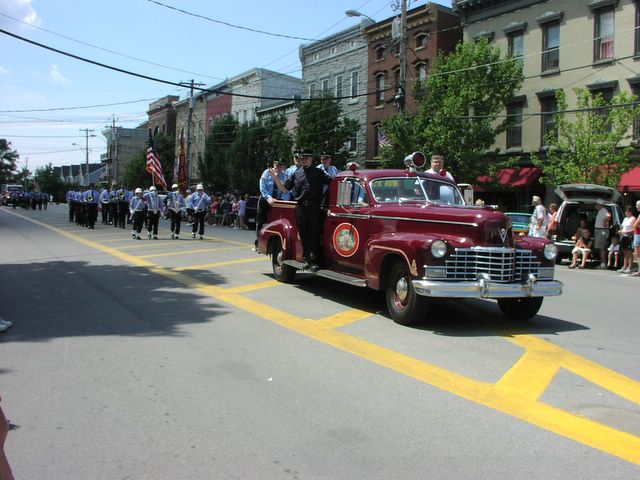
For a look at what the area around the old coal docks and a view of the rail bed, see the photos below. I slipped in a view of today's parade and the old parade vehicle owned by the Clayton Calumets that I recall from my childhood days. There were brand new ones in the parade too, and a couple of genuine antiques, as well as the volunteers in their spiffy dress uniforms.

If you look closely at the photo of the granite outcrop with the picnic table in Frink Park, you can see where the railbed was. In Clayton's heyday, some 16 trains a day came in bearing passengers who detrained not thirty feet from the water's edge. By the 40's and 50's. the rails had mostly been removed, except for the ones leading to the coal shed, and these were set in the grooves visible in the photo. Again, for a good look at the passenger cars pulled in to the terminal, see "Images of America, Clayton". The cover shot and several photos inside will convince you that Clayton was indeed, the destination of choice for thousands of late 19th and early 20th century tourists. From here they took steamers or steam yachts to the many elegant hotels in the islands and at Alexandria Bay down the river.

The second photo of the waterfront park shows the ice and age damaged cribbing which supported the heavy wood structure forming the shore side of the terminal. It is this that I look at each year and try to reconstruct in my mind. The wood portion of the dock extended much farther north than it seems now, and the tall (to the youthful eyes of my memory) coal piles would have been to the right, or south of the river edge, with coal dust blackened roadways in between each pile. The Riverview Hotel was still there then, not yet replaced by the Frink Offices built after the Frink Plant fire. The chain link fence still keeps me out. In the old days, pre this highly litigious era, a fence was unnecessary. Now, someone might fall and sue, ending the dream of razing the plant and replacing it with shopping, culture and residences.

Remains of wood piled coal dock Posted by Picasa

Rail Bed as it is today Posted by Picasa

Clayton Summer Parade Posted by Picasa

Saturday, May 07, 2005

Chapter 3

I haven’t said much about the river, or Clayton for good reason. Anyone who claims to remember things clearly as a 3 year old is probably recalling later memories, or fibbing or both. Maybe I shouldn’t say that. Maybe there are prodigies whose memory of being born is clear and accurate. I doubt it. Mine sure aren’t, and since my Dad was thoughtful enough, and had the records available to provide me with my I.Q. at too early an age for my own good, I’m pretty sure I’m not just too dumb to remember. It is more that what needs to be said about the real Clayton and the real river have to be experienced again, at the source, before being committed to paper. That done (it happened or is happening this summer) we can continue...

I can say that there was this great big, blue, river right there nearby. A river that Dad just loved from day one in Clayton, I think. The only problem was, despite most Claytonians opinions to the contrary, we were relatively poor. Principals of schools didn’t make much then. We couldn’t afford a boat, let alone a motor for one. We didn’t even have a car for a long time, but borrowed a school station wagon for trips when possible. Something that would be scandalous in today’s school systems, but was done with the approval of the powers that be. Dad would never have done something such as that if it was not so approved. We could, and did walk a lot however. Mom wasn’t much of a walker, but Dad loved to walk around town. Often he would take me with him. Sometimes we would walk to the rail yard downtown. Sometimes we would actually walk the tracks.

The rail yard was my favorite. To look at it today, you would not know Clayton even had a rail spur, nor what it was used for. It is gone, now, totally erased. If you want to see where it was, look at an old map, or ask a local. You can still walk the old bed, a wonderfully raised clear trail from which you overlook swamps and golf course and old pastureland. Start on the East Line Road (you may have to search a little on the north side of the road) where it rises slightly after crossing the “T” at upper Graves Street. You can walk all the way down to Mary Street, where you will lose it in development that took place after the tracks were taken up.

The railroad of my childhood had two uses actually. Now, those of you reading this book with real historical knowledge of Clayton please forgive me. Once again, I am seeing this from a child’s perspective, not from a historical viewpoint. The history is hard to find nowadays, but it is there if you know where to look. The Thousand Islands Museum has some excellent references, for example. My brother Jack and his wife Marylou once gave Carol and me a lithograph of an old drawing of Clayton in the late 1800’s, a copy of which you can obtain from the Shipyard Museum. Our copy hangs in our living room where I can look at it now and then, and clearly shows what it probably looked like at the bustling terminal when steam excursion trains arrived in the area “downtown” by the coal docks.

In that last paragraph, you find the two major things the railroad brought to Clayton: tourists and coal. They also took back with them milk produced locally. Most of the traffic up and down the St. Lawrence River was powered by coal, and Clayton was a coaling station for passing steamers. Some of those steamers were local, some from outside the area, and some carried passengers and mail to and from the island homes of millionaires, and the resort hotels like the Frontenac on Round Island. Long before the American highway system metastasized into what it is today, the rail lines were the main arteries of transport. The line to Clayton was the only rapid transit to the Thousand Islands. If one reads of the folk who were entertained at Boldt Castle, and Calumet Castle, Dark Island Castle and Mr. Pullman’s Castle-like home near Alexandria Bay (hereafter known as Alex Bay for short), it is clear that they arrived by train.

My boyhood walks with Dad were not to see hordes of such tourist folk, for they were mostly gone by then. You could get to Clayton by car in the 40’s and 50’s. We did, however see the steam engines pull in, and sometimes, sometimes if we were lucky, there would be a mail car and a coach with them. Most of the time it was coal cars and milk trains, though. Dad and I, and sometimes Mom, would walk down to the docks and see the train, and I could tell one of those times might be coming when we heard the steam whistle blowing as the train came into town. Over the crossing at the East Line road, down past the golf course, past the decaying marine structures along the bay fronting Washington Island it came. We’d walk, and sometimes drive down and get as close to the train as we could. Close enough to smell the steam and oil and feel the heat from the engine.

Then we moved to Beecher Street, nearer the school and farther from the river. Oh, we still went down there after that, but at some indefinite time (that time in your life when spring and summer and fall and winter seem to blend in together, and there are no date markers and you didn’t look at a calendar with any real understanding) it all went away. In the 50’s, diesel replaced steam and the shrieking toot as the engine approached the East Line Road crossing became the honk of an air horn. I remember Dad saying something about the railroad making the horn louder (they finally did) so people could hear it better before it killed someone at that crossing.

What I recall best is the way the tracks were cut into the orangey quartz laden bedrock just off the street, down by Frink’s Snowplow works. You can still see where the tracks were, if you know where to look. Carol gets bored, I’m sure, when I walk down memory lane with her in that spot, so changed as to be unrecognizable. The oil you got on your shoes, the ever present coal dust and the noise, all gone now. In the late 50’s the big wooden structure housing the coal bins and machinery for coaling burned. The fire siren went off and my mom took us to see the fire, which burned for days if my memory is correct. I took my Kodak Brownie Hawkeye camera down there and took pictures of the skeletal remains. Those photos, along with many others that I took of Clayton, are gone now, lost in the Great Hurricane Agnes Flood of 1972 in Elmira, NY. I wish I could have saved them.

I remember looking out of the big plate glass windows of the Driftwood restaurant at the blackened beams. By then, the coaling station was rarely used anymore except for coal sold to heat homes, diesel also having replaced steam as a power source for the lake freighters plying the big, blue St. Lawrence.

That area of Clayton brings many confused memories of my childhood. Confused because they don’t have dates connected to them in most cases, and I’m never sure which ones came where in the time scheme. The Utard sank at the coal dock, and we went to see it in answer to the siren’s song. A gas tanker sank in frigid water in the same place after hitting (I think) the same shoal. The latter was when I was in high school, and the pictures have been lost also. Once, while wasting time with my best friend Bryce down by the town docks, we saw a boat come in and a body was carried off and laid out on the dock. I don’t really know if I saw what I seem to recall, but I knew that the dead person was a scuba diver, and that some boater had ignored his floating buoy (or he didn’t have one, I’m not sure) and had run him over. He had prop marks on his back, an all too common way for divers to be injured or killed. It was the second dead body I had seen.

When I was barely 8 or 9, my next door neighbor died. He was an old man, and well liked in the town. Tom had been a school custodian and handyman, and had been very kind to me. He smelled of cigars, and had a gruff voice. Years later, whenever I saw a Popeye cartoon, I would remember him for some reason. When he died, the “viewing” and funeral were held at his house, a traditional Irish thing, I think, but again, there’s that memory thing. My brothers insisted that his ghost would haunt me forever if I didn’t go to the viewing and see him. Mom did not want me to go. I went next door, and did not see into the casket, but had nightmares about his ghost for a while.

Dad and I, and sometimes Mom, used to go to the coal docks to fish. They fished, I watched. Having no boat, the best way to fish was to get as close to the water as you could. You couldn’t get closer than that without a boat. Sometimes they fished and I would wander among the coal piles (large chunks of soft coal, not the small hard coal nuggets. Both were present, but I knew not to climb the latter, or play around them, as they could fall easily) and coal dust, pretending they were mountains, or forts, etc. Some of the chunks had fossil outlines in them if you broke them open. Sometimes I took paper and drew clouds and sunsets, which I imagined were very artistic, and received much praise from my parents. As I got older I realized that they were encouraging me out of love, not because I could draw well.

The older I got, the more independence they gave me. I wandered far afield, as far as the old round table used by the railroad to turn engines around. I watched the sparks fly inside the doors of the Frink plant. I threw stones at frogs, snakes and anything in general I knew would not break. I somehow knew that if I broke things, Dad would not be happy. I wandered up and down the old rail tracks, balancing on the rails, sometimes falling and skinning a knee. I watched the clouds build high in the west, fantastic tall shapes over the tops of the coal piles, with the sun gradually falling behind them. I liked to pretend they were ships, or planes or huge people. Children still look with fascination at clouds, but I wonder, with TV, do they still imagine they see the Red Baron and his Sopwith Camel, or castles in the sky?

As darkness approached, I would return to the river, on the old brown railroad tie dockside, and wait for them to finish fishing. Sometimes I would sit near the edge, on the sun warmed ties, and sift the dried wood rot smelling of creosote through my fingers, or just sit and watch the sun set in fiery orange. Now, there is little left of those ties, except split grey slivers and metal rods poking out of the jumbled rocks at the north end of the waterfront park that replaced the old yard. Frink’s is closed, there is a fence preventing anyone from wandering into the property, and the winter waves have taken most of the wooden dock frames away. My Dad’s spirit reminds me that going around the no trespassing sign is a bad idea, so I never do.

Instead I stand on the blacktop paved area where bands now play in summer, and day dream of the three foot great northern pike Dad pulled out of the river within a hundred feet of the viewing benches now meant for concerts, not victorious fisher folk. I see the look of determination on his face as he worked the black nylon high test line and the silver Shakespeare reel, the green metal rod bent in a tense arc nearly to the water. The sun is setting, and I am awed by the struggle. Several people are watching, and one realizes that the net lying by Dad’s feet won’t bring the fish in. He runs to his car and gets a larger net with a long handle, and a gaff hook materializes from somewhere....

Just like the other Clayton memory photos in my collection, this one has to remain a memory etched by that fading sun’s rays. I lost the only copy I had of Dad holding that big fish, me standing next to him, fish as nearly as tall as I was. Someday, if you see me standing there, looking out at the river, that is what I am seeing. The fish coming into the net, gill hooked with the gaff, the rod still bent, then the fish thrashing around in the netting on the dock timbers. My Dad sought Muskies year after year, but never caught one. I believe that his moment with this pike made up for that. I have often silently wished the fisher-folk I see there good luck as they persevere against all odds in their attempt to catch the big one off that dock.

Chapter 2 BABY STEPS (1)

Chapter 2 BABY STEPS

I don’t know how you feel about first memories, but whenever I hear anyone talking about theirs or read about them I find myself questioning my own memories. I have learned that we remember things differently than others around us, and tend to color the memories with our own experiences, sometimes reformatting a memory to suit what we would like to remember about a certain incident. Not all memories are flattering, nor are they all pleasant. Don’t worry; I’m not going to dwell on the latter. I will say, though, that my life has produced some of the former that I would just as soon forget, and as a result, some of those memories may be, well, colored more favorably.

When my Dad, Robert A. Charles, and my Mom, Ruth (no middle initial) Fowler Charles moved from Mooers to Clayton in the early ‘40s, I was only two years old. Dad was to be the new principal of a new school partially constructed at the beginning of WWII, and would eventually preside over the finishing and enlarging of the school which became known as Clayton Central School, or “CCS” as many called it. I was too young to know about, or to understand, the local politics involved, and have not since delved into it enough to know all of the details. Suffice it to say that Dad was popular with some, not so popular with others, and Mom.... well, Mom was Mom. She had 4 active boys to rear, and had no real interest in the social life of Clayton as a principal’s wife, but you can’t avoid that in a small town. She wanted people to like her for what she was, but it was difficult.

Ruth Fowler grew up in the “big city" of Syracuse, New York, and probably had “big city ways” stamped on her record somewhere in people’s minds. That was funny, because by 1944 she had lived in Mooers, Pompey and North Lawrence, New York on and off for 10 or more years. She and Dad were married after meeting in New York City. Dad worked for a fruit company there, and Mom worked for Woolworth’s. I have never been too clear about their courtship, as by the time I was old enough to understand such things, she had stopped talking about them. Like many children, I made the mistake of remaining ignorant of that subject until it was too late. Mom died several years ago, and I just never got around to asking again. I do know that they loved each other very much, and though they sometimes fought like cats and dogs in their later years, it would never last very long.

Many of the experiences I had were family experiences, and revolved around all of us getting into an old car and going somewhere: Branchport, New York on Keuka Lake to visit Dad’s father, Dr. Oscar Charles, a retired dentist; Syracuse, New York to visit Mom’s sister, Carolyn and Uncle Leo, her husband; and once, to Binghamton, New York to attend Mom’s Aunt Lena’s funeral. Sometimes these trips were boring and interminable; sometimes they were the most exciting part of the year. We always took a slightly different route, occasionally combining a trip to see Grandpa and Grandma Charles. Grandma was Oscar’s second wife, Mila. His first died of cancer before I was old enough to know her. Often there would be a side trip through Syracuse. Sometimes, we went to the place where the school bought buses, and Dad would drive a school station wagon back. Those were fun trips, but I don’t recall any details. I learned to read at an early age, and often killed the time with a book, occasionally looking at whatever scenery was passing by.

When I was about three, WWII ended, and my earliest memory, literally, is of the huge noise outside. The Clayton Fire Department (Still, I believe, known as the Calumets) was then located about one hundred feet south of our rented house, and had an air horn siren on a mast right outside the building. On VJ Day, so I am told, there was great celebration in the land. Church bells pealed, and fire sirens went off every few minutes (to me it must have seemed all day, and maybe it was!) to announce the news. Japan was defeated: the war was over! I don't recall VE day, but then, we could have been out of town at the time.

I also learned as I got older, that all of my senses were more acute than normal, except for my eyes, which were affected by amblyopia, and which had caused me to be “walleyed.” Since my eyes weren’t good, my hearing probably overcompensated, and what a lasting effect that had on childhood! Both a curse (that siren sure was loud and frightening) and a blessing (I could hear conversations about things like Santa Claus, whispered across the room), having acute hearing caused some funny and sometimes embarrassing situations. More about that later.

That loud noise, both joyful and terrifying, was my first clear memory; probably because my Mom and my Grandmother (Mom’s mother lived with us at the time) tried so hard to make me understand that it was a joyful thing, not something to be afraid of. I have no clear memory of how they stopped my tears and, no doubt, loud crying, but they did. In later years, the fire siren was to take on many different meanings in my young life, but that was the first. What I remember most, however, is the love and comfort that followed successive siren songs.

Later, and time was not one of those things a three year old could relate to, Mom began to illustrate her lifelong passion for change of scene. Since she could not leave and return to Syracuse, where she apparently left her heart, (not in San Francisco where she had traveled with her sister as a girl) she elected to engineer at least 5 moves while living in Clayton. Admittedly some were options for better housing, but in her later life, she continued to love moving from home to home to home. Oddly, until later in my life when I became aware of the backbreaking labor involved in moving, I found these moves comforting, albeit confusing when I was a child.

I really don’t know how Dad felt about these relocations, as I never heard him complain about them. Either he did not mind or he saved his complaints for when I was not within earshot. I recall a lot of Pig Latin being used when I was a child, but I soon caught on to that, too. Once, we moved to a house near the school, our second to last location in Clayton, and just a few hundred yards from the front door, which was good for Dad, because he could spend more time working and less time walking to work.

That was where I began to relate to animals, I guess. We always had a dog or a cat or dogs and cats or, well you get the picture: some kind of animal, bird or fish. It was the first time I was left to my own resources, I guess, because my Mother was very protective of her children, and normally would not have let a 5 year old alone with so much open space around. The stress of moving, and my being a typical curious child led to my wandering off behind the barn with the white cat, Marshmallow or Fluffy or whatever, and a short piece of rope. The house sat back from the road a great distance, to my childish eyes, and the barn was huge and dark. I wanted the cat to follow me around for company, and when it deviated from that path, I tied the rope in a loop around its neck and towed it into the high weeds behind the barn.

Now, I know that sounds like a cleaned up version of what actually happened, but it is the truth as I remember it. I was not, as it was later reported by my family, torturing the cat. Since I was six years away from becoming a Boy Scout, my knots weren’t very good, but the slip knot I inadvertently tied around kitty’s neck was very effective. She lay down and began to choke and gasp. I immediately ran to my Mom, and yelled something like “there’s something wrong with the cat!” Like Lassie with Timmy down the well, I led them to the troubled kitty, and one of my brothers rescued her. “Something’s wrong with the cat” became a catch phrase for Joey getting in trouble after that. I really do love cats, to this day, and would certainly never do anything to harm one on purpose. But it became obvious that day that I did not take well to being teased! My brothers took a perverse delight in “pulling my chain” ever after, and still do. I wouldn’t have it any other way.

All of us have things we would wish hadn’t happened, or at least had happened in a different, less embarrassing way, I suppose. Like my dad, I have high blood pressure. Like my Dad, my face goes red easily. It was one of those ways people could tell he was angry. I recall a friend saying “Boy, your dad was so mad at (So and So) his face got as red as a tomato!” Well, mine does too, and when I laugh, and when I am embarrassed. I think my earliest memory of shame (which was not all that shameful, but a normal childhood thing) was when a girl playmate, some two years older than me, offered to show me her “bummy” for a quarter. I have no idea how old I was, maybe 5 or 6, but I remember casually announcing to my shocked family at the dinner table that I had seen my first “bummy.” Into the silence that followed came a huge roaring of the wind in my ears, as I realized that something I had said had caused one of those “moments.”

I would not read or hear the term “faux-pas” for many years, but the embarrassment generated by having seen a pair of white undies flash by my astigmatic eyes for a second has lasted to this day. Not that it ranks right up there with finding my fly down in public, but just as memorable. Even as a child, I guess, I was prone to opening my mouth and saying inappropriate things at inappropriate times. Stepping ahead, I would love to take that one back, and many others, but you can’t unsay things. It caused me to lose a good playmate, who was only doing something all kids do, or think about doing, the equivalent of “playing doctor” but even more innocent. At some point, adults come into the picture and innocence turns to guilt. Thus, when I lost my babyhood/childhood innocence about many other things, my Dad’s principality was among them. If I struck out at you, dear reader, as a result, please accept my apologies. See this book for what it is, a tribute to a good place to grow up. One of the firm groundings of my life as an adult has been that I shall never stop learning from experience. Like everyone, the lessons are not always remembered at exactly the same time as they are needed, but they are remembered.

Friday, April 29, 2005

Chapter 1, P.K.: continued, (end)

In those days the use of child psychologists was rare, and Dr. Spock was just hitting his prime. My parents could not have afforded one anyway, though Mom had a copy of the Spock book. The best advice Mom got came from Dr. Pilpel, our family physician, who said she should just stop worrying about it and I would eat sooner or later. The worst came from the school physician, Dr Folkes, who told her he feared I was malnourished, (I was anemic) and needed to be force fed. I got a combination of the two advises, along with something called “Vidalin,” a noxious honey like liquid that was supposed to increase my appetite and provide vitamin supplements. It spoiled my love of honey for a while. I was “punished” a lot for not eating what everyone else was eating, and sent to my room. No, I was never spanked for it, or treated bad physically or mentally. It was just, well, constant. One does, after all, have three meals a day normally. Grandma would bring a cookie or some other treat up to my room. When Dad discovered this, he would tell her in quiet fury that she was “meddling” in the boy’s upbringing. She kept doing it anyway, of course.

Like all brothers everywhere, mine were sympathetic to a degree. But like all brothers, they also loved to tease. Since I was the youngest, smallest and “sensitive”, it was easy to tease me. Ways were found to make macaroni and cheese sound even less palatable than their odor already rendered them. A comparison to maggots was one of the more gentle ones. Of course, when I refused to eat something like Spam (it had all kinds of things ground up in it you know) or hot dogs (don’t go there!) and the lumps in the mashed potatoes were cooked parts of bugs, I attracted Dad’s attention. The conversation went something like this:

Mom: You haven’t eaten anything but your (fill in the things a kid would like). Eat your string beans!
Dad: I never saw anyone cut the meat away from the fat before. Why do you do that? Cut the fat away
from the meat!
Dick: (sotto voice) you know they grow beans in dirt? Mom doesn’t wash them, either.
Joel: Stop that!
Dad: All right, that’s enough. Joel, go to your room.
Mom: Young man you sit right down. You’re staying at this table until you finish those beans! And eat your hot dog!
Dick: (to low to be heard by parents) They put dog’s eyes in those, you know...

It often became a contest of wills, and of course, there was the family pet...

Jim: Mom, Joe’s given the dog his meat again!
Mom: All right young man, you’ll sit here until the last of that hamburger is gone, and I’ll be watching you!

Now what kid hasn’t experienced some of that? Of course, I had three very loving (and very typically sadistic) brothers, who loved to start things. That always happens to the youngest. Later in life, when I realized that they would do anything (particularly my brother Dick) to protect me, I came to love them even more. I think they wanted, consciously or not, to help harden me against the cruelty of the world, and may even have worried, along with Dad, that I might become a “homo”. With all this, lying around with one eye in the dark, being unable to breathe through my nose, sometimes unable to catch a breath at all and probably weak from self induced hunger, it is little wonder that I had protracted bouts with asthma. But there is more.

Dick, who was four years older than I, had very serious asthma attacks in the middle of the night; so serious that the dreaded fire siren blew in answer to Dr. Pilpel’s call for the “inhalator”. Mom would get frightened (probably not as frightened as Dick, who could not catch his breath) and call the doctor from his bed at 2 am. The doc would give him a shot, prescribe some benadryl, and go home usually, but on occasion, the call had to be made. Dick was what would now be called an overachiever. When Dad referred to his asthma problem, he often said Dick needed to learn to “pace himself” so that he wouldn’t do more than he could handle without going into a breathing problem. He eventually was able to do that, but never lost his enthusiasm for doing things full out. He just decided he would conquer the problem, and did. It could be said he “outgrew” it. I would say he conquered it. But he never beat the hay fever, even after he saw a succession of allergists for shots to desensitize him to the various toxins from which he was likely to go into massive histamine reactions to.

My asthma may have been psychosomatic, due to fear, nervous reaction, etc., but I don’t think so. Even today I have so many allergies (including hay!) that I am never sure what it is that is making me sneeze, wheeze or break out. I can not use liquid fabric softener, or fabric softener sheets in the dryer, and if someone uses them before my clothes or bed clothes go in, I break out in an itchy rash and may sneeze a lot. Sprays like room deodorizer, fabric softener, deodorants, etc.; perfumes and body powder, carpet shampoo, the cleaning supply aisle in supermarkets... all choke me up and or make me sneeze.

In grade school, a classmate named Bill lived on a big farm. There was a big hay barn there, and it was a favorite place for Bill’s other friends and my classmates to play. I only went there once, as I really am allergic to hay dust, but it was a traumatic experience. It was the discovery that boys like me were expected to be thrilled with the concept of danger, the possibility of pain. The main attraction of the barn seemed to be the hay loft. The 8 or 10 foot (since I didn’t have a ruler, it didn’t get measured) drop was child’s play, unless you were an undernourished 10 year old with huge glasses, hay fever, asthma and stick thin arms and legs.

While many of my classmates were enjoying the playground, playing ball, raising 4H animals on the farm, enjoying kick the can and hide and seek in the evenings, I was inside, sniffling and wheezing and reading. As a further complication, the drugs available for these afflictions were likely to turn the strongest individual into a zombie. Try being 30 pounds underweight and playing ball with coke bottle bottoms strapped to your face and perpetually sneezing, wheezing and coughing while unable to coordinate your limbs. To this day, I can not fathom what people see in getting “high” on drugs. I spent my youth “high” on things that made me sleepy, dopey and uncoordinated. When I was able to quit taking them (I just stopped, one day) I never went back. Ah, sports! The local paper just published a story about schools possibly being required to drop dodge ball. Boy, do I wish they’d done that in 1950! You haven’t really lived until a squishy, sweaty red or blue dodge ball has smashed your glasses into your bony nose and left a long lasting red welt on your cheek where the lenses hit. OK, that’s not so bad, but now try it with a softball, then a baseball. And, since you can’t see very well to the sides where your glasses don’t cover, basketball passes take on a whole new meaning.

All right, enough whining. It was probably no harder than any other normal kid’s life. Actually, I look back on those years with a good deal of nostalgia, for they were the time in my life that I was not aware that being a P.K. was a hard row. That was one of Dad’s favorite expressions: some person’s “got a hard row to hoe...” meaning the person referred to had a difficult time with something. How about this for a hard row: “Your dad and mom are rich. You’re just a spoiled rich kid. Everybody knows the principal gets paid lot of money. My dad has to work for a living. Yours just has to show up at school an boss everybody around.” Or, “I hate your father; he’s mean. He... (fill in the blank). Or, this or that kid is going to take out his or her frustration on you, and never tell you why. They don’t need to. You just know. So, you develop a method of getting through it. You have some choices: you can get thick skinned (or appear to) and just take the punishment. You can become mean and a bully (if you are big enough) and get even. You can retreat into your shell and avoid contact with everyone who might hurt you. You can convince yourself that you have the moral high ground, and become a priggish defender of your own moral code, and a sharp tongued smart ass. You can become a wild, nonconforming, hard drinking man’s man who finds a way to fit in by rebelling. Or, you can do a combination of all those things and have people wonder about your sanity. One thing some children do when bullied and isolated for some reason is become mass murderers. I guess I had a good upbringing. I didn’t ever take any of the guns I had easy access to as a young hunter and kill anyone. Never even thought about it.

I refuse to use the background I have for an excuse. I am what I am because of what I experienced, and it was by no means all bad. One of my best friends in high school used to beat me up regularly in grade school. It was really more of the “say uncle and I’ll stop” variety, but the effect was the same. He once asked me why I didn’t fight back. I said “why do you beat me up?” We both realized that it was pointless, and when he reached that point he stopped and never did it again. He died young, before I had a chance to tell him how much I respected him. Another boy used to hit me on the head with a book in study hall; hit me hard. When I got up and moved, he moved with me. Mr. Netto would ask me why I was moving around, what was going on. I did not tell him. Eventually, the hitting stopped. When I got older, I realized that that boy, now a man, was not a monster, just a misguided boy with a sense of mischief who knew an easy mark when he saw one. He is a much better man today from his own life experience, and I like him.

Some years ago at a class of ’60 reunion at the C-Way restaurant I was standing at the bar, waiting to get a drink for my wife and myself. Carol was at a table with some friends. A woman who had obviously had enough to drink to allow her to express a long held opinion said loudly “you’re that Charles kid, aren’t you?” I said yes, I guess I was. She said “I hated your old man. I just wanted you to know that.” I said “well, OK, have a nice day.” or something like that. We’re talking 30 years here. The man had been dead 20 years. She still feels the pain, for whatever reason. I would say to her, today, as I would say to anyone else with the same sentiment, “get over it. Move on. I have.”

My Dad was a school principal because he loved it, not because he could not do anything else, and not because he liked inflicting punishment or enforcing rules. He enjoyed the light that seems to go on in a student’s eyes when he or she learns something. All good teachers do. He was a fair man, and would never have done something to deliberately hurt anyone. When he showed me my I.Q. score, it was to make me aware of a potential that he saw in me, not to make me into something he wanted me to be or feel bad. He had no way of knowing the damage it did, and was probably incapable of seeing that it might not help but hurt. I grew up believing he felt I was letting him down, not living up to my potential. I finally understand that he just did not want me to waste my abilities. I wish I’d had the wisdom to understand then.